
When Your Digital World Stops
Technology makes our lives easier but is often fragile. A practical guide to personal preparedness for cybersecurity threats and infrastructure disruptions — and a checklist you can share with family, friends, and colleagues.
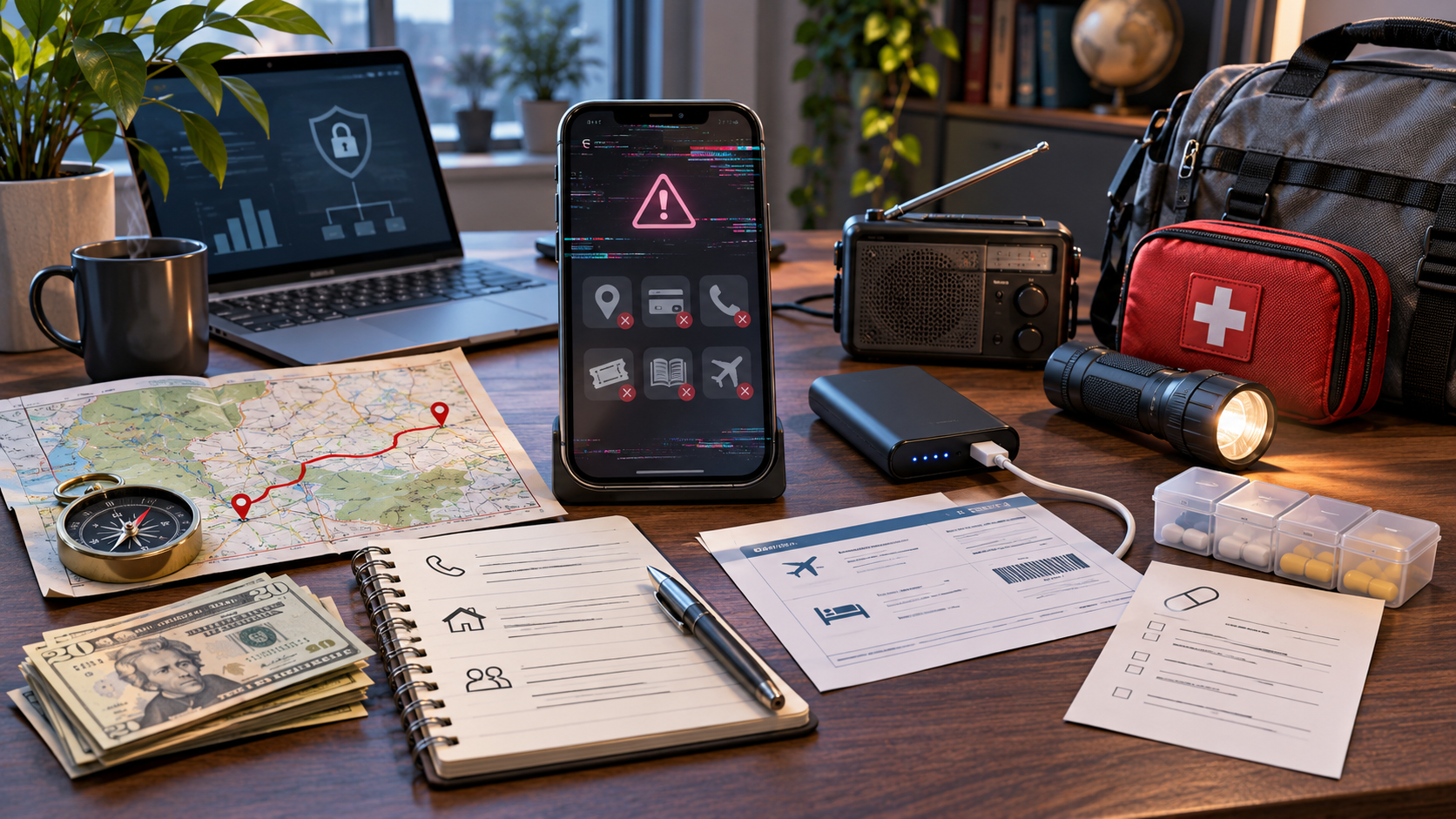
This week, we're shifting our focus from organizational resilience and business continuity to something closer to home: personal preparedness. With cybersecurity threats and infrastructure disruptions making headlines, friends and family may be looking to you for guidance on what they can do to protect themselves.
For those of us who work in technology and cybersecurity, many of these recommendations will be familiar. You may have even shared them with others before. But knowing what to do and taking the time to do it are two different things.
Consider this week's blog a practical refresher for your own household and a checklist you can share with family, friends, and others who may be concerned about what they're seeing in the news.
Technology makes our lives easier but is often fragile. A little preparation can make us more resilient when technology fails.
We live in an extraordinary age of convenience. We pay bills without writing checks, consult doctors remotely, book transportation in seconds, and manage much of life through a device in our pocket.
But there is a tradeoff: as our lives become increasingly connected, we also become increasingly dependent on systems we neither own nor control.
A disruption to a banking network, healthcare system, communications provider, transportation service, or electrical grid can quickly become a personal problem. It doesn't have to be a cyberattack. Software failures, equipment malfunctions, power outages, human error, and natural disasters all have meaningful and negative effects.
Even the most reliable technology can fail. What matters is how prepared we are when it does.
The challenge for many people is simply making time to do it. Checking batteries, updating emergency contacts, getting cash from the ATM, and reviewing household supplies aren't complicated tasks. But when your days are consumed by demanding work and family responsibilities, they're easy to postpone.
The good news is that preparation does not require technical expertise, expensive equipment, or an elaborate emergency plan. It starts with a few practical considerations. We're simply looking for resilience until an issue or crisis is resolved.
Know your dependencies before they fail.
In business continuity planning, identifying dependencies and single points of failure is fundamental. But how often do we apply that same thinking to our personal lives?
Consider the systems your household relies on for communication, transportation, healthcare, financial transactions, and basic necessities. Then apply a familiar approach:
- Identify what you depend on
- Determine what happens when it is unavailable
- Arrange a realistic alternative. The best plan is one you can remember and will actually use.
An old, but still relevant military planning methodology is the PACE plan: Primary Plan, Alternate Plan, Contingency Plan and Emergency Plan. You don't need four elaborate systems for every aspect of your life. Rather assess the essential vulnerabilities of your life, reaching family, paying for food, obtaining medication, etc., and address those. Preparedness means thinking beyond your daily, and usual, routine. Consider what you would do if your normal way of accessing an essential service suddenly became unavailable. Identify practical alternatives, establish backup plans, and know what steps to take if those alternatives also fail. The goal is to make informed decisions before a disruption occurs, instead of trying to develop a solution in the middle of a crisis.
This may be familiar territory for anyone who develops contingency plans professionally. The difference is that at home, there's often no assigned team, formal review process, or deadline to ensure the work gets done. It's up to us to make it a priority.
1. Financial preparedness: What if you can't access your money?
Your funds may be safe when payment systems or banking apps are temporarily unavailable, but those funds can be difficult to access until the situation is resolved. An outage may leave an account intact while cards, ATMs or apps cannot process transactions.
Consider how many everyday transactions depend on functioning payment networks, internet connectivity, and electricity. Even if your bank is operating normally, a disruption elsewhere in that chain could prevent you from completing a purchase.
- Keep a modest amount of emergency cash on hand, in small denominations, and stored securely.
- Maintain at least one, preferably two, credit card payment method(s) from different institutions or networks than your primary source of payment.
- Know how to reach your bank(s) without relying on an app or web interface. Keep bank customer-service numbers and account numbers offline, in a safe location.
- If practical for your financial circumstances, maintain accessible funds in multiple institutions.
There's a significant distinction between convenience and resilience. An emergency reserve should be separate from the card, wallet, or bank account you use every day.
2. Medical preparedness: Medical information should travel with the patient.
If a portal or pharmacy system is unavailable, a short, accurate paper record can help you communicate essential medical details in the event of a medical emergency.
- Maintain a private list of medications and doses, allergies, major conditions, physicians, pharmacy, insurance and emergency contacts.
- Discuss refill and after-hours contingencies with your pharmacist or clinician. Don't change medication use or stockpile without guidance.
- If you use powered medical equipment such as a CPAP, nebulizer, or oxygen machine, plan backup power and emergency care with your clinical team.
Keep this information accessible for when you need it, but protected from casual exposure.
Think beyond your own needs. Would a spouse, parent, adult child, or other loved one know how to access essential medical information during an outage? Have you reviewed medication lists and contact details recently to make sure they're accurate?
3. Transportation/Navigation: Have a way home that doesn't depend on an app.
A phone can be your map, ticket, payment method and ride request — all at once. But if the network goes down, you could lose access to all four at once.
For someone traveling on business, losing access to those services in an unfamiliar city can create problems quickly. Could you reach your hotel, find an alternate route, or contact a colleague without relying on your phone?
- Download offline maps and retain important addresses and phone numbers on paper.
- Always carry a charged power bank and cable.
- Keep cash for transportation.
- Print or write down reservation information, itinerary details, and confirmation numbers before travel.
- Know an alternative route or service, and share longer-trip plans with someone you trust.
4. Communications: Make a plan before you need to coordinate.
If cellular or internet service is disrupted, family members should not have to invent a plan while separated.
- Write down key phone numbers and identify an out-of-area contact.
- Plan multiple means of communications with your significant contacts.
- Agree on a meeting place and a reasonable check-in plan if calls and messages don't work.
- Maintain a backup charging method for electronics and a battery-powered radio.
PACE is especially useful here. Your primary channel may be a call and the alternate might be text. A contingency might be an agreed meeting place, and the emergency plan might be contacting local emergency services when available.
The key is making sure your alternatives don't all depend on the same infrastructure. For example, switching from a voice call to a messaging app may offer little protection if both rely on the same cellular network or internet connection. Effective backup plans account for shared dependencies, not just different methods of communication.
You may have helped develop communication plans for an entire organization. But have you talked through a plan with the people in your own household? Make sure everyone knows what to do if they can't reach you directly.
5. Digital access: Keep essential information available offline.
Important records now live in cloud environments, portals, and apps. When those services stop responding, the information can be inaccessible even if it has not been damaged.
- Store offline copies of critical identification, insurance details, and household records in a secure place.
- Keep travel confirmations and key service telephone numbers in a format you can access without internet.
- Maintain an encrypted local backup of important files and test that you can actually open those files.
- Find out whether critical services have telephone or in-person alternatives.
A backup is only useful if you can reach it. Keep sensitive records secure, and don't place complete banking credentials on a printed emergency sheet. And don't assume that having a backup means you're covered. When was the last time you tested it? Verify that your files are accessible, your storage devices still work, and the information you've saved is current.
6. Household essentials: Start with 72 hours.
A three-day reserve is a useful starting point, though local emergency guidance may call for more.
- Keep drinking water, shelf-stable food, first aid, flashlights, batteries and a radio.
- Don't forget to include supplies for children, pets and household members with specific needs.
- Store emergency cash, essential papers in a small ready-to-go kit in secure, known locations.
- Account for any essential equipment that depends on electricity.
Already have emergency supplies? Check them. Batteries lose their charge, food and medications expire, and generators require maintenance and an appropriate fuel supply. A kit you assembled years ago may no longer meet your household's needs.
7. Practice: A plan you never test is just a list.
Organizations test their incident response and business continuity plans because identifying a weakness during an actual disruption is far more costly than finding it during an exercise. The same principle applies at home.
Try a 15-minute household exercise. Without switching off essential services, imagine your internet, payment apps and mobile phone are unavailable for an indefinite period of time.
- Can you buy food, contact family, and reach medical information?
- Can you navigate home or to another destination if traveling and identify your next option if your first fails?
- Can someone else in the household find the supplies and instructions?
- Have you tested your backup plans recently, or are you assuming they'll work because the supplies and equipment are in place?
- Review the plan periodically and update what has changed.
Preparedness should be proportional to your circumstances, not an endless shopping list. Start with your most consequential single point of failure and fix that first.
Preparedness isn't fear. It's independence.
Technology is an extraordinary tool. But it's not a substitute for awareness, judgment or a workable backup plan. Effective preparation is personal, practical, and learned through repetition. Resilience is built through action not reaction.
For leaders responsible for organizational resilience, personal preparedness has another dimension. During a major disruption, your colleagues and clients may depend on you to make decisions, coordinate a response, or restore operations. That's considerably harder when you're also worried about whether your family has food, medication, a way to communicate, or a safe way home.
Taking care of the basics at home can help you remain focused when others are counting on you professionally.
None of these recommendations are particularly sophisticated, especially for people accustomed to managing complex technology environments and high-stakes decisions. But that's precisely the point. Knowing what needs to be done doesn't mean we've made time to do it.
Share this checklist with someone who could benefit from it, whether that's a spouse, parent, adult child, friend, neighbor, or colleague. Then take a few minutes to review your own preparations.
Start small: Identify one essential digital dependency you have in your life this week and then identify a second way to accomplish the task that is connected to that dependency.
DIGITAL PREPAREDNESS CHECKLIST
A personal readiness check for technology disruptions
Knowing what to do is different from being ready. Use this checklist to review your household's preparations, verify that your backups work, and identify what still needs attention. Then share it with someone you care about.
MONEY & PAYMENTS
- ☐ Emergency cash in small denominations, stored securely and readily accessible
- ☐ Backup payment methods from different institutions or networks; bank contact numbers on paper
- ☐ Confirm that backup cards are active and haven't expired
MEDICAL
- ☐ Updated medication, allergy, doctor and pharmacy list available offline
- ☐ Prescription / medical equipment contingency discussed with care team
- ☐ Essential medications, supplies, and backup power needs reviewed for your household
TRAVEL & TRANSPORTATION
- ☐ Offline maps, key addresses, and alternate routes home available without connectivity
- ☐ Printed/saved tickets, reservation details, and a charged power bank and compatible cable
- ☐ Alternative transportation and payment options identified before travel
FAMILY COMMUNICATIONS
- ☐ Printed contacts, out-of-area contact, and agreed-upon meeting place
- ☐ Backup charging options and a working battery-powered radio
- ☐ Family members know the communication plan and what to do if you're unreachable
DIGITAL ACCESS
- ☐ Secure offline copies of essential records and confirmations
- ☐ Encrypted local backup of important information, tested to confirm files can be opened without internet access
- ☐ Backup devices, passwords, and recovery methods checked for accessibility
HOUSEHOLD / 72-HOUR STARTER
- ☐ Water, food, battery-powered lights, batteries, first aid and necessary supplies
- ☐ Accessible go bag and supplies for household-specific needs
- ☐ Expiration dates, battery charges, and backup equipment checked
- ☐ Generator fuel and maintenance verified, if applicable, following safety guidance
PRACTICE & UPDATE
- ☐ Walk through a one-day outage scenario with your household; identify shared dependencies and single points of failure
- ☐ Test at least one alternative, rather than assuming it will work
- ☐ Review contacts, supplies, and plans every few months
PACE: Primary → Alternate → Contingency → Emergency.
Do your backup options depend on the same infrastructure? What will you do if your first alternative also fails?
Preparedness is not fear. It is independence.
Knowing the plan is a start. Putting it into practice is what makes you ready.
Explore Topics
Written by
AXE55 Technologies
Intelligence, discovery, insights and stories.